Home / News and resources / How to choose preclinical models before you commit to IND-enabling studies
How to choose preclinical models before you commit to IND-enabling studies
Investigational new drug (IND) and clinical trial applications (CTAs) require a robust preclinical data package that establishes the scientific rationale and safety case for taking a novel candidate into first-in-human trials. This typically includes good laboratory practice (GLP) toxicology studies, safety pharmacology and pharmacokinetic assessments, all of which are costly and time-consuming.
Before committing to these studies, sponsors need confidence in a candidate’s efficacy and human relevance, which depends on preclinical models that genuinely reflect human biology. Without them, investigators cannot be confident that readouts predict clinical outcomes. Relying on models that do not fully represent human tissue is a major contributor to the translational gap between preclinical promise and clinical results. A false positive can lead to continued investment in a weak candidate that is likely to fail in the clinic. A false negative can lead teams to wrongly deprioritize a viable asset. Both are costly, and both undermine confidence in the development decisions that follow. Decisions based on unsuitable models cost time and resources, and can halt the development of potentially disease-modifying therapies, a particular concern in areas of high unmet need such as fibrotic disease.
In this Q&A, Dr Lee Borthwick, Chief Executive Officer and Co-Founder of FibroFind, explains how to match model systems to the questions asked at each stage of drug development, and how human precision-cut tissue slices add value to a preclinical data package.
Key Takeaways:
- IND-enabling studies commit a programme to formal toxicology, manufacturing and regulatory spend, so the go/no-go decision before them is critical to get right.
- Understand the strengths of each preclinical model, and when best to use them: cell-based assays for target activity, animal models for systemic exposure, and intact human tissue for disease responses in a human-relevant biological setting.
- A negative result is only meaningful if the model performed as expected, with viable tissue, a measurable disease response and responsive controls.
- Human tissue data strengthen pharmacology and mechanism-of-action evidence. Under the FDA’s 2026 draft guidance on new approach methodologies (NAMs), sponsors are encouraged to consider alternatives to animal studies, where appropriate, as supporting evidence for IND applications, provided the method is fit for a defined context of use. Human tissue data complement, rather than replace, formal safety studies.
What is the value of a preclinical study in drug candidate assessment?
Preclinical studies are a critical stage in drug development. They show whether a candidate has enough evidence of efficacy and safety to justify further investment, and they generate the data needed to progress to first-in-human studies. Preclinical evidence determines whether a programme advances, changes direction or is terminated, so an incorrect decision at this stage can have serious consequences.
Advancing a candidate on insufficient evidence often becomes costly later in development. A 2016 analysis of 640 novel therapeutics that entered phase 3 or pivotal trials between 1998 and 2008 found that 344 (54%) failed. Inadequate efficacy accounted for 195 (57%) of these failures, more than three times the number that failed because of safety concerns [1]. Preclinical models that better reflect human disease could identify candidates with poor efficacy or safety liabilities before they reach the clinic.
Conversely, weak or negative data from inappropriate preclinical models can prematurely end the development of safe and effective therapies. The cost of these missed opportunities is difficult to quantify, because abandoned candidates are rarely tested further. This is why introducing human-relevant models earlier can help avoid incorrect decisions during screening.
How do you choose the right preclinical models to support an IND application?
Model choice matters at every stage of preclinical development. Each model has different strengths, and using several in combination builds a stronger data package for an IND application.
For example, a cell-based in-vitro assay can give fast, cost-effective readouts of target activity early in development. However, these assays lack the complexity needed to assess systemic pharmacokinetics or safety. In-vivo animal models can address systemic exposure, but they often fail to reproduce human disease biology, which limits how well efficacy findings translate to the clinic. Human ex-vivo models, such as precision-cut tissue slices, help close this gap by measuring disease-relevant responses in intact human tissue. Because many therapies affect several cell types and the interactions between them, models that preserve this cellular complexity are particularly valuable.
I advise teams to start with the decision they need to make and the biology behind it. Then, for each model, ask three questions: what can it measure, what will it leave uncertain, and will its controls make the result interpretable? Budget and timelines matter, but a cheaper study has limited value if it can’t resolve the uncertainty behind the next investment decision. Regulators are moving in the same direction: the FDA Modernization Act 2.0 (2022) and the FDA’s 2025 roadmap for reducing animal testing both support greater use of complex human models in preclinical development. This also matches the FDA’s position in its 2026 draft guidance: a NAM is evaluated on whether it is fit for a specific, stated purpose, known as its ‘context of use’ [2].
How common preclinical systems compare
| Preclinical system | Best suited to answer | Main limitation |
| 2D cell assays (cell lines, primary cells) | Target activity, potency and early compound ranking at high throughput | No native tissue architecture, extracellular matrix or multicellular context |
| Organoids and 3D spheroids | Some 3D cellular organization and patient-to-patient variation | Variable maturity; usually lack native matrix, vasculature and resident immune cells |
| Animal models | Systemic exposure, pharmacokinetics, whole-organism effects and formal safety studies | Species differences in target biology and disease can limit translation |
| Organ-on-chip and microphysiological systems | Effects of flow, mechanical forces and connected tissue compartments | Engineered rather than native tissue; standardization and throughput vary by platform |
| Precision-cut human tissue slices | Whether target engagement changes a disease-relevant response in viable, intact human tissue in a higher-throughput system | Finite culture window; no systemic exposure |
What are precision-cut tissue slices, and what can they tell you?
Precision-cut tissue slices (PCTS) are thin, uniform sections of viable, intact human tissue. They retain the organ’s native architecture, extracellular matrix and resident cell populations, which allows us to test whether engaging a target produces a disease-relevant response at the tissue level.
At FibroFind, we use ethically procured human liver, lung and kidney tissue, obtained with full informed consent through UK transplant and clinical networks. We work with both diseased tissue, spanning a range of disease stages, and healthy tissue in which disease can be induced in culture, so therapies can be tested in established human disease or in a controlled model of disease development. Each organ is assessed for transplant suitability at retrieval, so the tissue is well-characterised, and we process it within hours of receipt to generate fresh PCTS. Tissue is never freeze-thawed, which helps preserve its native biology and functional characteristics. This gives us confidence in the quality and interpretation of our downstream readouts. Every donor is different, and we see that as a strength: donor-to-donor variation mirrors the heterogeneity of a clinical trial population, and we manage it by testing across multiple donors.
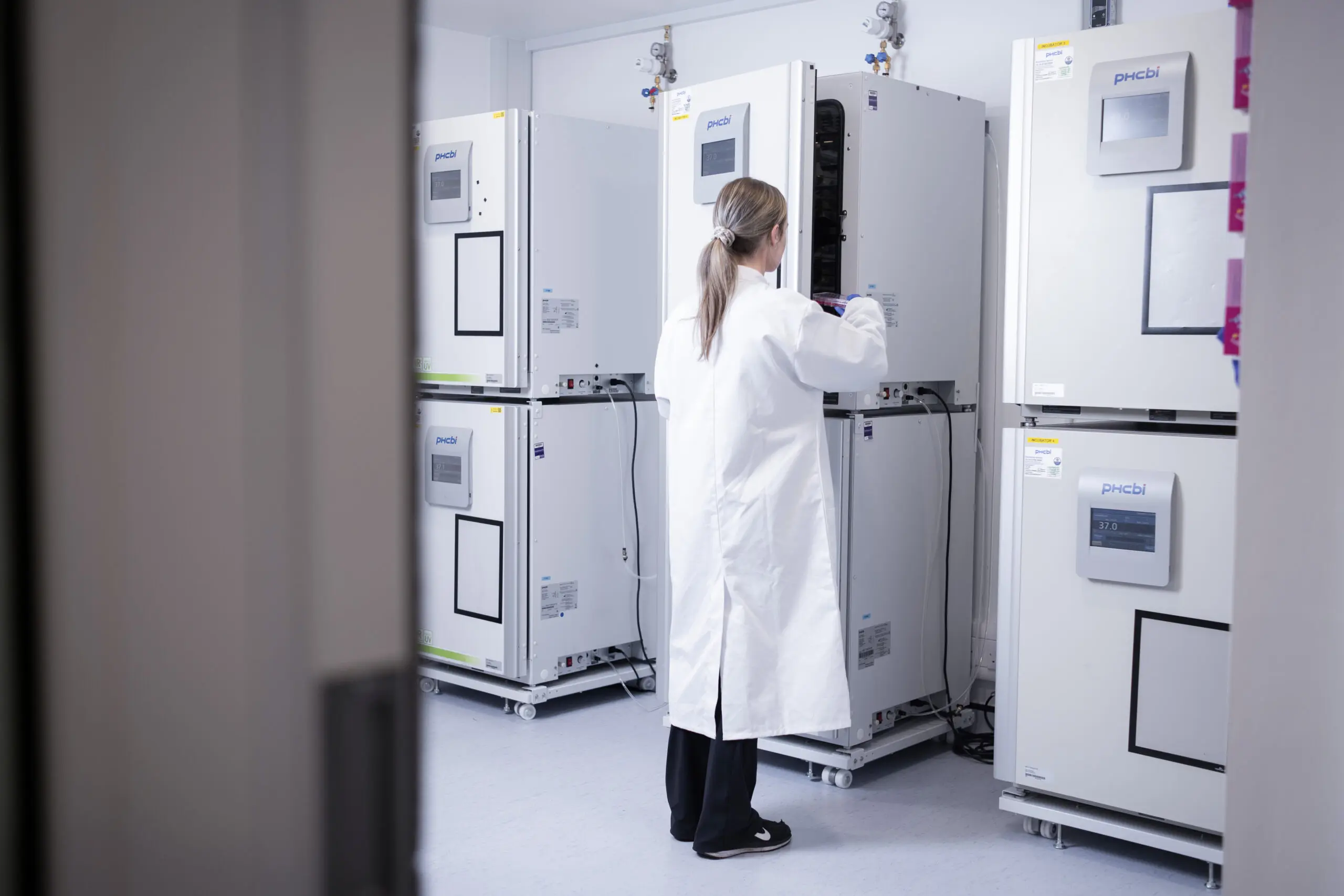
Our proprietary bioreactor maintains PCTS under controlled physiological conditions for up to 10 days, preserving tissue architecture, active cellular signalling and disease phenotype for long enough to model disease and test interventions. During culture, PCTS retain all native cell populations (with the exception of neutrophils) and can be treated with test compounds throughout. Diseased PCTS are therapeutically dosed, while healthy PCTS can be dosed prophylactically alongside a disease-inducing stimulus to model the development of disease. PCTS and culture media samples can then be analysed for numerous readouts covering tissue viability, target engagement and therapeutic responses.
When should human tissue testing enter a drug development programme?
Human tissue testing adds value at several stages, especially when utilised in preclinical studies prior to IND applications. Early on, it can rank a shortlist of candidates on safety and efficacy, so that decisions to advance or drop compounds are based on a clinically relevant model. My concern is that ranking compounds in less relevant models can advance a candidate that later shows little activity or unexpected toxicity in human tissue, or exclude one with therapeutic potential.
High-throughput screening, mechanistic studies, pharmacokinetics and formal toxicology each answer different questions as a programme progresses. Once a lead candidate is selected, human tissue supports more in-depth, disease-specific studies to confirm its mechanism of action, adding to the pharmacology evidence for an IND application.
What does a negative result mean for the go/no-go decision?
A negative result can justify a no-go decision, but only if the study itself performed as expected. A reliable negative result helps a team identify concerns early and redirect investment towards more promising candidates. Before acting on it, our scientific and medical teams check that the study gives a sound basis for interpreting the candidate’s response. For example:
- Did control slices remain viable and functional throughout culture, and show the expected disease phenotype, whether established or induced?
- Did the experimental controls and any standard-of-care benchmarks behave as expected?
If any check fails, we repeat the study in tissue from a new donor at no extra cost. If the checks pass, we examine compound exposure, target engagement and endpoint relevance to understand why there was no treatment effect.
Candidates can be tested alone or in combination with approved standard-of-care drugs. Combination testing is increasingly important, because many patients entering clinical trials will already be receiving standard of care interventions. Understanding whether a candidate adds benefit on top of standard of care, or interacts with it adversely, can inform both the IND application and trial design.
Overall, this evidence helps teams change course earlier, saving time and resources that could otherwise go into an unsuccessful programme. Put simply, a well-designed negative result is legitimate grounds to stop or redirect, and an early, evidence-based ‘no’ can be as valuable as a ‘yes’.
What should you expect from a human tissue study partner?
First, access to fresh, high-quality, well-characterised human tissue. We have processed hundreds of human organs for our platforms, and our standardized processing gives consistent, reproducible PCTS from every donor.
Second, a study designed around your scientific question(s). We work with clients at every stage of preclinical development, and our scientific and medical teams help define which questions need answering and the most appropriate way to answer them.
Third, complete and transparent outputs. At the end of each study, we provide raw data, analysis files, summary tables and a written report, so clients can examine the findings themselves. We can also interpret the data, advise on communicating the findings to investors and stakeholders, and support IND application content on request.
Together, this gives you data you can genuinely stand behind. Every study is built on fresh, well-characterised human tissue and is benchmarked against appropriate controls. This helps ensure that a response reflects the candidate’s activity rather than an artefact of tissue quality or study conditions. Whether the result points to a go or a no-go, you’ll have a clear, defensible basis for a confident development decision.
Speak with FibroFind to discuss a tailored liver, lung or kidney tissue study that tests your candidate in human biology before you commit to IND-enabling studies.
References
Hwang TJ, Carpenter D, et al. “Failure of Investigational Drugs in Late-stage Clinical Development and Publication of Trial Results”. JAMA Internal Medicine. 176:12 (2016). 1826–1833. https://jamanetwork.com/journals/jamainternalmedicine/fullarticle/2565686
FDA. “General Considerations for the Use of New Approach Methodologies in Drug Development”. Center for Drug Evaluation and Research. 2026. https://www.fda.gov/regulatory-information/search-fda-guidance-documents/general-considerations-use-new-approach-methodologies-drug-development
Related resources
Poster
Combination of an Acetyl-Coenzyme A Carboxylase Inhibitor and Fibroblast Growth Factor-19 Reduced Tissue Triglyceride Content and Fibrosis in Human Precision-Cut Liver Slices
See how combining ACC inhibition with FGF19 reduced triglyceride accumulation and fibrosis in human precision-cut liver slices.
The evidence your program demands
Speak to our team about your program.